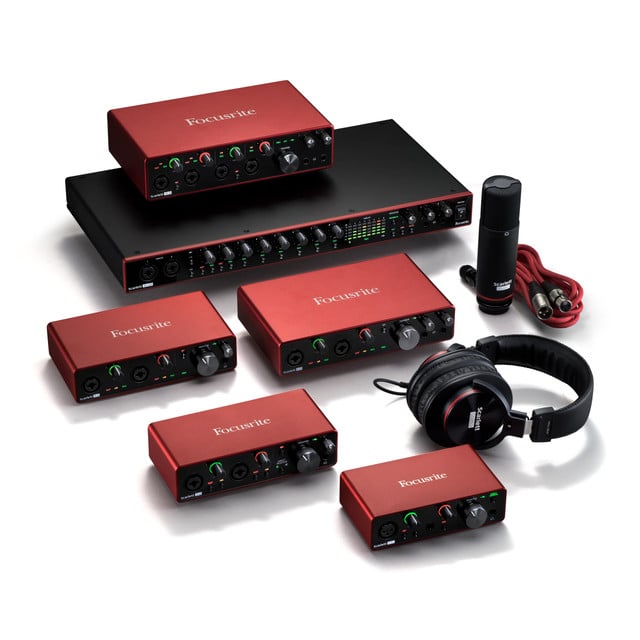
Scarlett vs Clarett+ is a question many experienced home and project studio owners eventually face once a first interface starts to feel limiting. Both ranges carry the
Focusrite name, yet they serve different stages of a recording setup. The comparison really comes down to preamp character, connectivity, and the kind of workflow each range was built to support. This article looks at design philosophy, input and output configurations, and sound signature across both lines.
The Legacy and Design Philosophy Behind Scarlett
Scarlett has long been one of the most recognised audio interface families from
Focusrite, built around 4th Gen preamps described as high-detail and ultra-low-noise. The gain range reaches up to 69dB, which lets a quiet vocal take and a loud guitar amp both be captured with similar precision. That flexibility is part of why the range has become a familiar sight on songwriters' desks and in home studios.
The design behind Scarlett leans toward broad usability without compromising core preamp quality. Each unit works with common recording software out of the box, including bundled access to tools such as Ableton Live and Pro Tools Intro+. That mix of straightforward setup and dependable sound has kept the line relevant through several hardware revisions.
Clarett+ and the Shift to Premium Transformer Preamps

Clarett+ represents a different ambition within the
Focusrite catalogue. Described as a range of premium-quality USB audio interfaces for PC and Mac, it builds on the strengths of earlier Clarett generations rather than starting over. The focus shifts toward high headroom, low distortion, and ultra-low noise, qualities that matter once a monitoring chain grows more demanding.
This is not simply a matter of a higher spec number. Clarett+ tends to suit engineers who have already identified a specific shortfall in an existing setup, whether that is noise floor, headroom, or inconsistent preamp colour between channels. As a result, the range reads less like a starting point and more like a considered next purchase for someone weighing Scarlett vs Clarett+ against real session demands.
Scarlett's I/O Configurations: From Solo to 18i20
One practical strength of the Scarlett line is the breadth of its input and output options. Solo is described as the songwriter's 2-in, 2-out interface, while the 2i2 is framed as the artist's 2-in, 2-out option with a different feature set. The 4i4 moves further, positioned as the original music maker's 4-in, 4-out interface with extra routing flexibility.
Further along the range, the 16i16 serves as the artist's and producer's 16-in, 16-out interface, and the 18i16 is billed as the producer's 18-in, 16-out model. At the top sits the 18i20, described as the engineer's 26-in, 26-out interface. That spread lets one product family cover a laptop songwriter's setup and a multi-channel tracking room alike.
Clarett+ Models and Their Studio Integration Points
This range is organised around fewer models, each aimed at a specific studio role. The 2Pre is described as a pure-sounding 10-in/4-out audio interface for the recording artist, suited to smaller setups that still want transformer-based preamp quality. The 4Pre steps up to an 18-in/8-out configuration, marketed as versatile and sonically true for the complete creator.
At the upper end, the 8Pre is framed as a powerful, studio-grade interface with wider input and output capacity. Each model is built to integrate into a larger studio chain, often alongside ADAT-enabled expansion units such as the Scarlett OctoPre or OctoPre Dynamic. That compatibility matters for engineers who need more preamp channels without replacing an entire interface, and it is one reason these are positioned as long-term studio components rather than one-off boxes.
Preamp Architecture and Sound Signature Differences
The clearest distinction between the two ranges sits in preamp architecture. Scarlett's 4th Gen preamps are tuned for low noise and a wide gain range, which suits sources from a condenser vocal mic to a cranked amplifier. Clarett+ instead leans into high headroom and low distortion, qualities that become more audible on complex sources tracked at higher levels.
These differences shape how each range is positioned rather than just how it is specified. Scarlett is pitched around everyday usability, while the other is pitched specifically on clarity and detail retrieval. For engineers who already know what a clean, high-headroom signal path sounds like, this contrast becomes one of the clearest ways to frame a Scarlett vs Clarett+ decision in practice.
When to Invest in Clarett+ Over Scarlett

A home setup built around a laptop and a handful of microphones may never need more than the Scarlett 18i16 or 18i20 configurations. A studio chasing more transparent, transformer-based preamps is the more likely candidate for a Clarett+ 2Pre, 4Pre, or 8Pre. Choosing between the two ranges is therefore less about allegiance to one name and more about matching preamp behaviour to the material being recorded, a distinction that sits at the heart of most Scarlett vs Clarett+ comparisons.
- Scarlett's gain range reaches up to 69dB across its 4th Gen preamps, giving broad flexibility for quiet and loud sources alike.
- Clarett+ is built specifically around high headroom and low distortion rather than maximum gain range.
- Scarlett spans from a 2-in, 2-out Solo unit up to a 26-in, 26-out 18i20, covering a wide range of channel counts.
- Clarett+ tops out with the 8Pre, a studio-grade interface aimed at larger integration needs.
- Both ranges support ADAT expansion through units such as the Scarlett OctoPre, allowing additional preamp channels to be added later.
- Clarett+ carries forward design strengths from earlier Clarett generations rather than representing a first-generation product line.
Anyone weighing Scarlett vs Clarett+ against an existing rack of outboard gear should also consider how many ADAT channels are already in use, since both ranges can be extended rather than replaced outright. The broader catalogue from
Focusrite, including ISA and RedNet products, shows that interface choice tends to be an ongoing decision rather than a single purchase. More detail on current configurations sits at https://focusrite.com.
Closing Thought
The gap between Scarlett and Clarett+ reflects two distinct approaches to preamp design and studio integration, each serving different recording demands.